


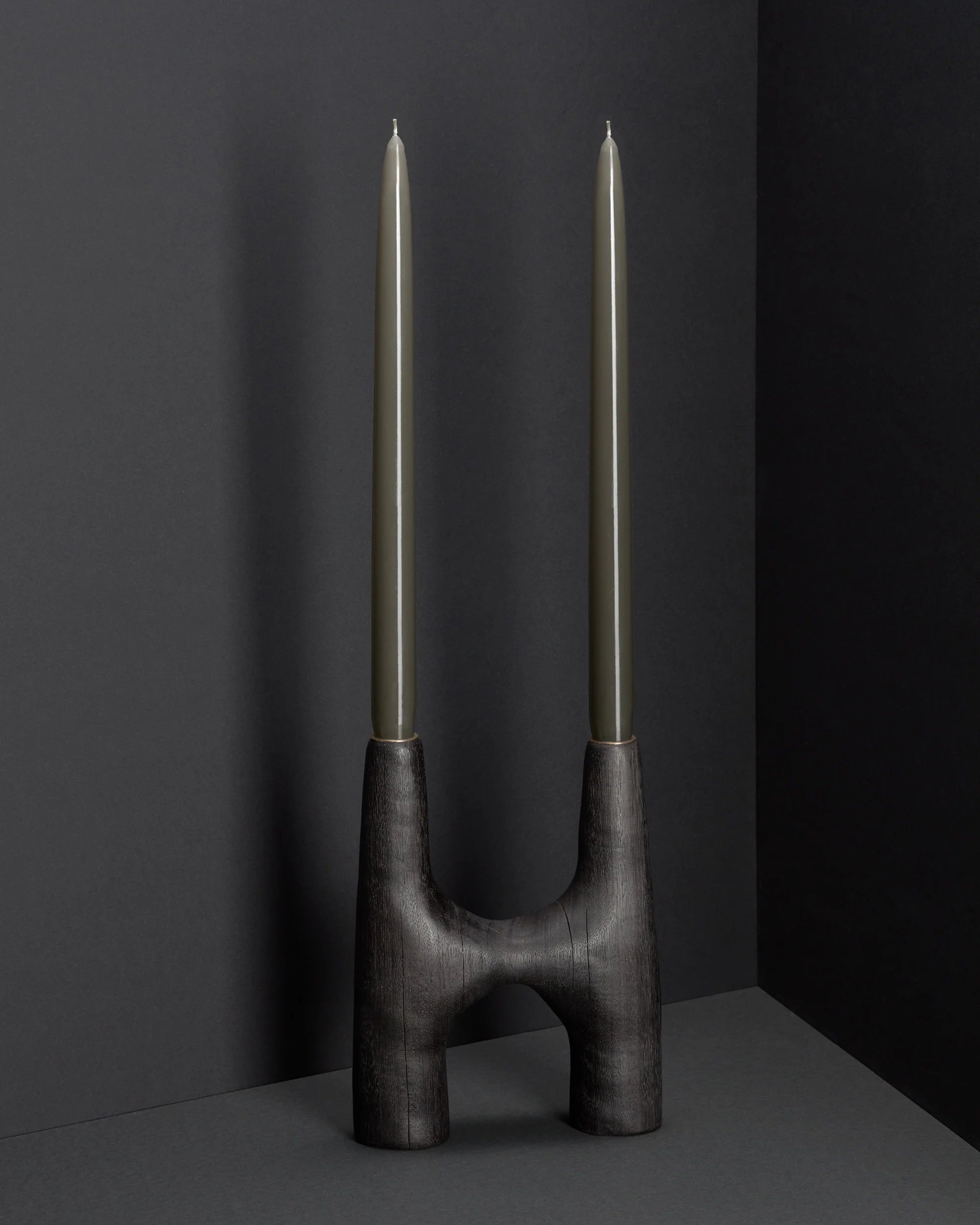
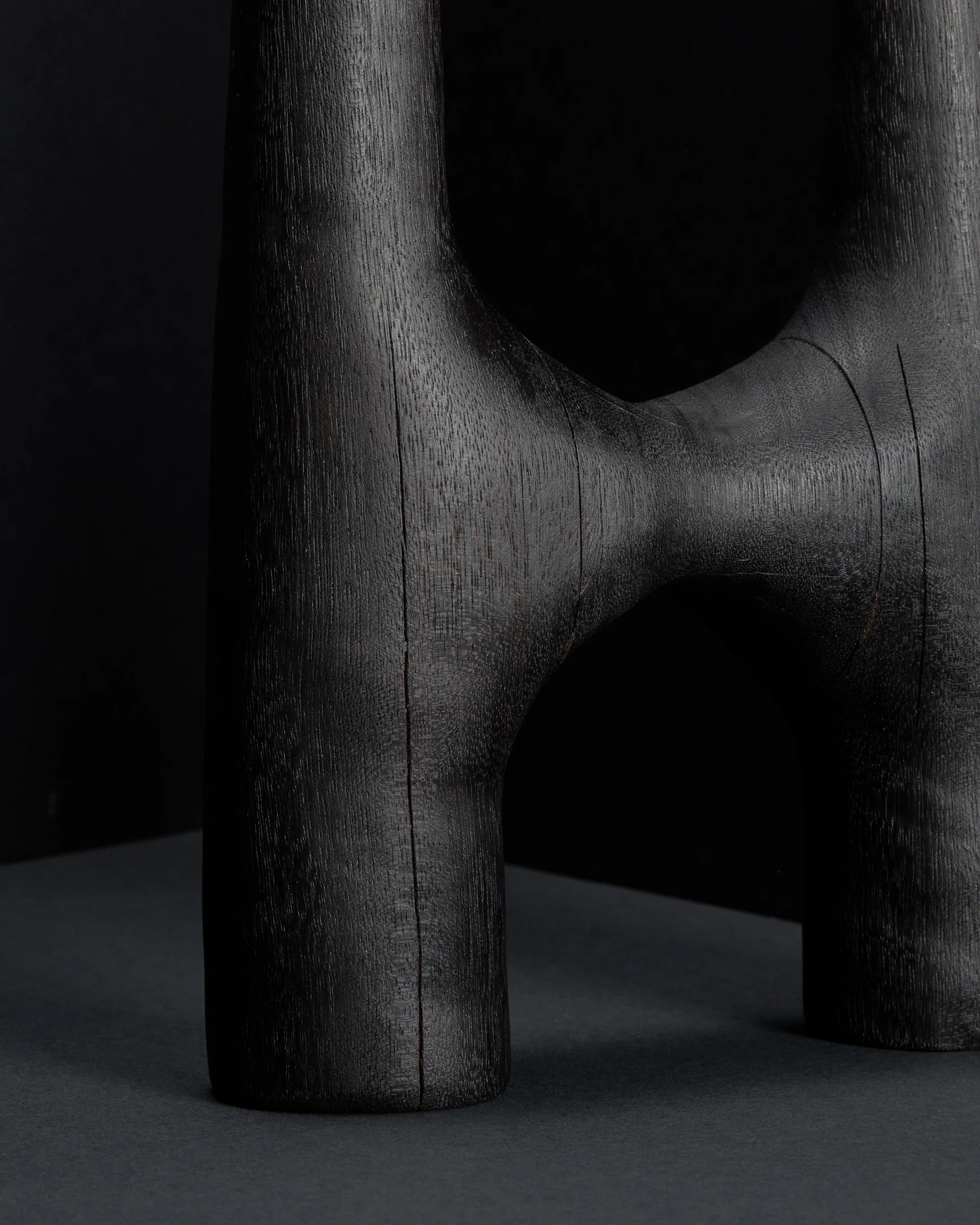

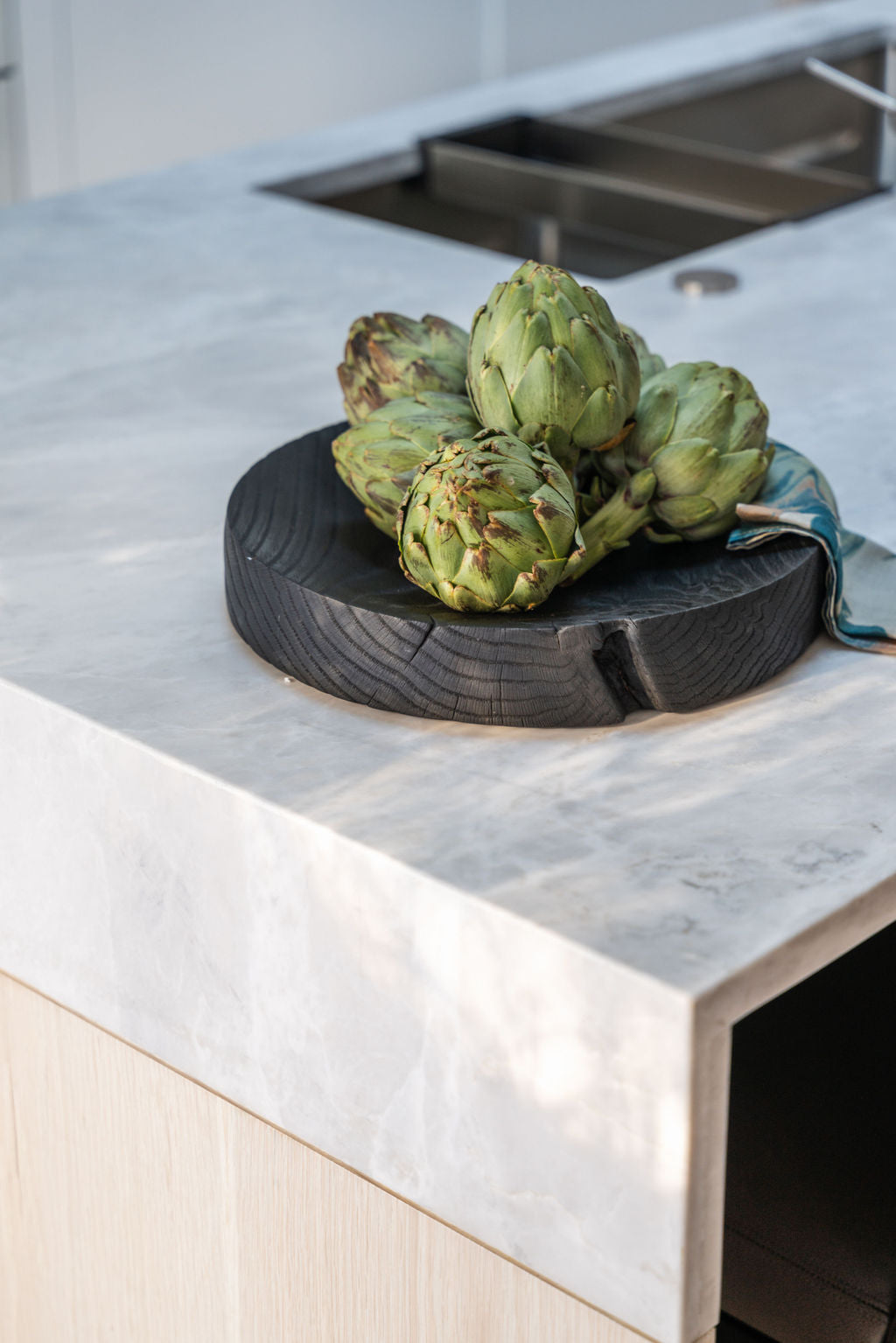
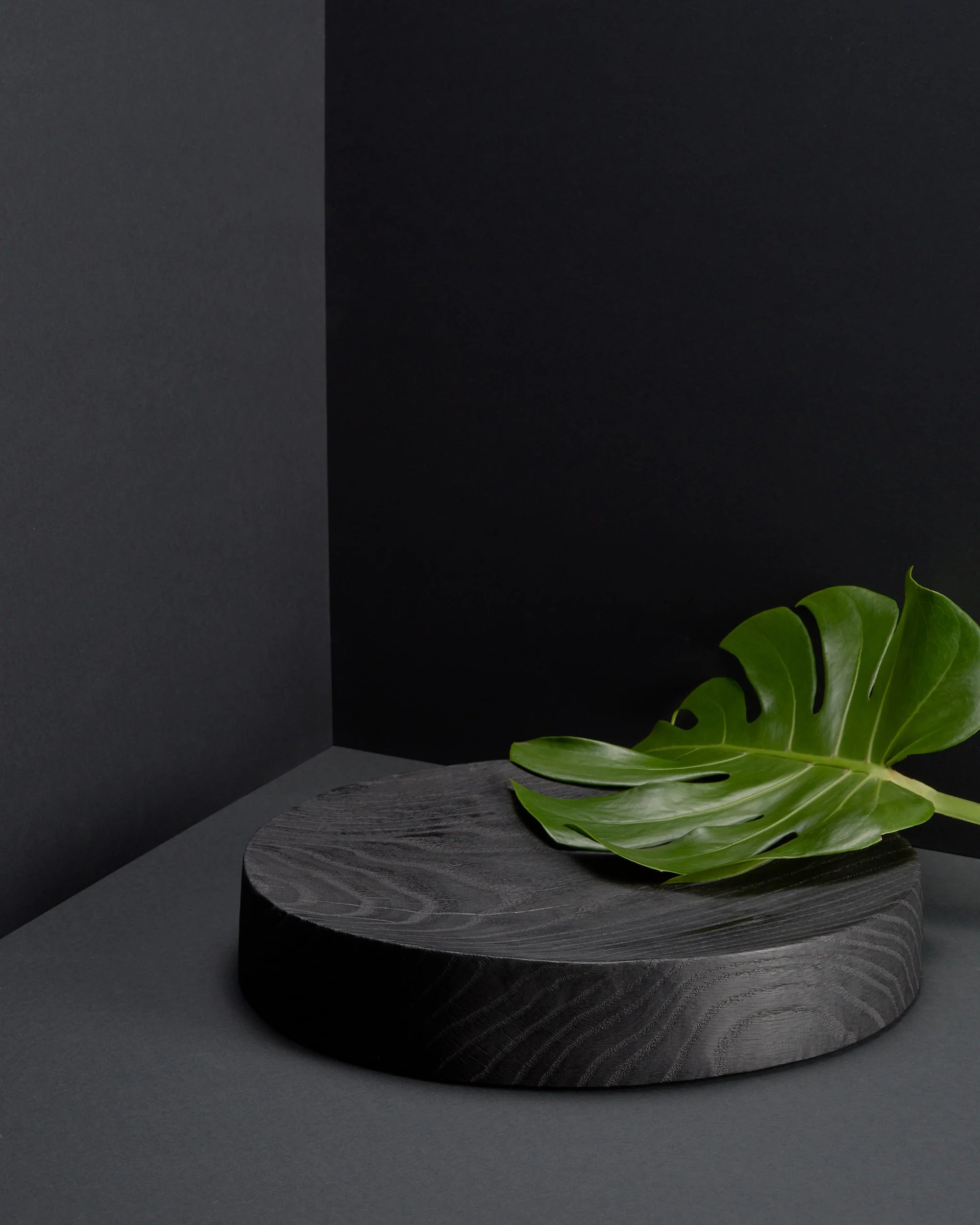

There are makers who describe what they do, and there are makers who reveal how they think. Emilia Tombolesi is the latter.
The London-based Italian designer behind the pieces you'll find in the Materie collection, Emilia works in repoussé — one of the oldest metalworking techniques in existence — transforming aluminium and copper into objects that sit quietly between sculpture and function. Her Etna collection, with its hammered metal and jesmonite cast in white sand, carries the personality of a Sicilian volcano. Her Luma lamps are finished by flame, their oxidation continuing long after the object leaves her hands.
What drew us to Emilia's work was not only the beauty of the pieces, but the intelligence behind them. The way she listens to her materials rather than imposing on them. The way failure, in her practice, is never final — it's the beginning of something better.
We sat down with Emilia to understand the thinking behind the objects.
1. Repoussé is one of the oldest metalworking techniques in existence. What made you choose a process that hasn't changed in centuries?
I just had a piece of scrap aluminium and wanted to make a tray for myself. Repoussé is usually appreciated for the "drawing" that appears on the opposite side of the hammering, so I decided to twist that narrative. In the Etna collection, the minimal "pushed" design becomes the functional aspect of the piece, while in Calypso the pushed metal was not only decorative but also functional, acting as feet. In this way, a technique that is usually used for decoration takes on a different meaning and purpose.
2. The Etna collection combines hammered aluminium with jesmonite and white sand — materials that couldn't be more different in origin. Can you tell us about how you decided to juxtapose those two materials?
This process happened by mistake. I had a very thin piece of aluminium in my hands and, silly me, I decided to bend it while keeping a sharp edge. The material obviously snapped. I ended up with a worked piece of metal, so I thought I might as well make a jesmonite base with it and use it as a mould. That's how Cratere was born.
I then decided to push the material further. How far could I go with the mould? What would help blend the point where the two materials meet? How sharp could the edges be? How strong could the material become? So I added sand. This not only gives a synthetic material like jesmonite a more organic feeling, but also makes it more structural, allowing me to maintain sharp edges. I think the collection works because extremely industrial, brutal materials become organic. It's unexpected, but it works.
3. Luma is made from copper transformed by flame. How much of that finishing process can you actually control, and how much do you leave to the fire?
I made quite a few samples before moving on to the lamps. It's an organic process, but you start to develop an eye for it. After a few tries, I knew when to stop to achieve the colours I wanted and where I wanted them to appear. It started becoming a semi-controlled painting technique. Moreover, the sheets aren't quenched, so the oxidation continues quite freely. There's no stopping the material from changing.
4. Seno reads as a breast from one side and a flower from the other. How much of that ambiguity is intentional, and how much did the material decide?
That piece is actually quite controlled. It came after a lot of practice on other pieces in the collection. Maschera was the first one, and the image of a face emerged organically. With Seno, I already knew how to work the material. I think it's the piece that best describes the narrative of the collection, having an image on both sides.
5. The Etna collection takes its name from a volcano the locals call "him." What does it mean to make objects from a landscape that already has a personality?
My family is from Sicily, and I have a very strong bond with the island. What's special about Etna is that it's a quiet presence that dictates life there. Locals have learned how to live with it and even use it to their advantage, but he's still the boss. If he decides to "talk," all you can do is grab a broom and sweep away the ashes.
I suppose I wanted to translate that story into the pieces: control on one side and resignation to the material on the other.
6. Your pieces sit between sculpture and function — a bowl, a tray, a lamp. Does the function liberate the form or limit it?
I think it liberates it. As much as I have a function in mind when starting a project, I never want to limit the material. I'd rather learn from it and adapt to it.
7. You're Italian, based in London. Where does the inspiration come from — the country you grew up in or the city you work in?
I have a very strong Italian and classical cultural background, so I'm sure most of my inspiration comes from that. What London — and studying there — taught me is the importance of failure. My experience growing up in Italy was that failure felt more final. In London, failure is often seen as a lesson and sometimes even a blessing.
8. Describe when your designs started to come into focus as an artist.
My designs are constantly growing and changing with me. However, I can clearly see that my design identity really started developing during my final university project. It was a sensory building set for neurodivergent children. Each piece had an anthropomorphic shape — a head, a torso, a smile — allowing children to build little dolls and characters.
Even though I've ended up making something entirely different, I can still see how those forms have stayed with me. I also see my designs reflecting different sides of myself. I do quite expressive work, and I hope to see it evolve alongside me for the rest of my life.
9. What do you make that you'd never sell?
I paint in my free time, and those are works that I never show and would never sell. With objects, on the other hand, I want them to be used, touched, and lived with. When I go to a design show, I hate it when you can't touch an object. It's a freaking object!
10. Luma's shade was inspired by the hats of Roman nuns. How much research goes into a single formal decision like that — and how much is just something you noticed?
Most forms emerge through iteration. I start with no limits, and then, as certain shapes begin to appear, I think, "That looks like this." From there, I try to get closer to the image I have in mind.
11. Your pieces are one-of-a-kind and made to order. In a market that rewards scalability, what does it cost you to refuse it?
From a practical studio perspective, I'd say everything. From a moral and philosophical perspective, nothing — and I'm happy with that.
I like getting attached to things. They carry meaning, stories, and memories. Even my phone, which is basically running on coal at this point, means something to me. I love that little box, and I hate that I'll eventually have to replace it.
I want my objects to become living presences in someone's life — something unique that somehow found its way to them.
12. When someone buys a piece and you never see it again — does the object still belong to you in some way?
Yes, they're my children. I visualise them throughout the process and then they come to life, so I get deeply attached to my pieces. But it makes me happy when someone feels a connection with something I've made, so I'm happy to let them go. At university, my tutor told me, "If they're your children, you'll need to let them go." I remember thinking, "I don't have children, but that makes absolute sense."
13. Is there a material that has defeated you?
All of them, I'd say. It usually happens when I try to impose what's in my mind onto a material. The process is never as predictable or linear as that. So I try to listen to the material and learn from it. I never quite get where I want to go, but that's what makes the process special and fun.
14. What would you make if no one was going to see it?
Two things.
As a proud Italian, I would give marble a try. And secondly, I would start welding. They're both major craft techniques that I deeply respect, and they intimidate me so much that if I ever have the confidence to show something, it will mean I've spent a lot of time mastering it.
If I ever make a welded piece, I want a mechanic to look at it and say, "Yes, that's a nice weld." I don't really care what the art world has to say about it.
Emilia's pieces are one-of-a-kind and made to order—objects that, in her own words, become living presences in someone's life.
We believe that entirely. It is why they have a place in the Materie collection.
Explore Emilia Tombolesi's work at Materie Home →


